
Frog art: giant trail frogs, bronze and golden frogs
A UK guide to frog sculpture, public art trails and frog prints

Sculpture
Bronze, stone, ceramic and fibreglass frogs

Trails
How animal sculpture trails began and work

Species
Golden, giant and monkey frogs behind the art
What counts as frog art
Frog art includes any artwork in which a frog is the subject or forms part of the work, from a pencil study to a large outdoor sculpture. It can be made using paint, ink, printmaking, clay, bronze, fibreglass or mural techniques. Some works aim to show an identifiable species, while others simplify the frog into a pattern, symbol or humorous character. The material and setting affect how a work is made, displayed and cared for. Looking closely at its surface, shape and details helps distinguish naturalistic images from more interpretive ones.
Painting, drawing and print
Two-dimensional frog art presents the animal on a flat support: paper, canvas, board, a printed sheet or a wall. A field-sketch approach may use graphite or watercolour to record a frog’s eye, folded hind legs and damp skin; acrylic and oil allow denser colour and layered texture. In printmaking, artists can build repeated images with linocut, woodcut, etching or screen printing. Each method leaves a different mark: carved lines in a linocut, fine incisions in an etching, or broad, even areas of colour in a screen print.
Artists may show a frog in a pond or among reeds, isolate it against a plain background, or use a close crop to emphasise its markings. A mural extends the image onto a wall and can incorporate architectural features, while a small print can be viewed at close range. Paper works are usually best suited to indoor display; light and damp can fade colours or distort paper. A painted wall is exposed to its particular indoor or outdoor conditions, so its surface and pigments affect how well it holds up.
The table compares common flat works with three-dimensional sculpture.
| Medium | Typical setting | Durability |
|---|---|---|
| Drawing or painting on paper | Indoors, often framed behind glazing | Paper can buckle in damp conditions; strong light can fade pigments. |
| Print on paper, such as a linocut or screen print | Indoors, displayed as a single sheet or edition | Paper remains vulnerable to moisture and light; the ink or printing process affects colour stability. |
| Three-dimensional sculpture | On a plinth, in a garden or in a public space | Durability depends on the material, finish and exposure to weather. |
For a close-viewed interior image, a framed drawing or print is practical; choose a mural when the wall itself is part of the composition.
Sculpture and public art
Frog sculpture turns the animal into a form that can be viewed from several sides. Ceramic, bronze and fibreglass each support different approaches: a ceramic frog may retain fingerprints or carved skin texture, bronze can carry crisp detail and a patina, and fibreglass can be moulded into broad, lightweight forms. The material is not always obvious from a photograph, so look for clues such as a bronze casting seam, a ceramic glaze or a mould line in a fibreglass surface.
Ceramic works are often made by hand-building or moulding clay, then fired and sometimes glazed. A glaze can make a smooth, reflective skin, while an unglazed surface shows the clay body. Cracks or exposed edges matter outdoors because water entering porous ceramic can contribute to damage during freezing weather. Bronze is cast, commonly using a lost-wax process, and develops a surface colour through patination; its weight and strength suit fixed outdoor displays, though corrosion and worn coatings still require attention. Fibreglass is formed over a mould and can be painted in vivid colours. Its comparatively low weight can make transport and placement easier, but paint and resin finishes may weather under sunlight and rain.
Settings range from a shelf or garden border to a civic square or a temporary outdoor installation. A small indoor sculpture can sit on a stable plinth; a substantial public work needs a suitable base and secure fixing appropriate to its weight and location. Placement changes how a frog is read: a sculpture close to ground level can seem poised to leap, while one raised on a pedestal becomes a focal point. In gardens, nearby plants and water can connect the form to a natural habitat without making the sculpture itself a biological specimen.
Conservation begins with identifying the material and finish rather than applying a general cleaner. A conservator may check bronze for unstable corrosion, ceramic for cracks and detached glaze, or fibreglass for lifting paint, open seams and water ingress. Distinguishing realism from stylisation is also possible through form: accurate joint placement and species-specific markings suggest observation, whereas reduced limbs, exaggerated eyes or repeated geometric shapes signal deliberate interpretation. Such details reveal whether the artist prioritised anatomical study, surface texture or an immediately readable silhouette.
Why artists keep returning to frogs
Frogs connect land and water, so artists can use them to suggest wetlands, rain and seasonal change. Their life cycle gives the subject a clear image of transformation: an aquatic tadpole develops limbs and becomes an animal able to live beyond the water. That change has made frogs a natural motif for renewal and new beginnings. Their sudden leaps, wide mouths and prominent eyes also lend themselves to humour, from a carefully observed portrait to a deliberately comic character.
Frog imagery has carried religious and protective meanings as well as playful ones. In ancient Egypt, Heqet was a fertility goddess linked to childbirth from the Middle Kingdom. She was shown as a frog or with a frog’s head, and her title was “She who hastens the birth.” Frog amulets were made in the New Kingdom, including the 18th Dynasty; an example is held by the Cleveland Museum of Art. Heqet also appears in the birth colonnade of Hatshepsut’s temple at Deir el-Bahri. These examples connect frog forms with fertility and birth in a specific Egyptian context.
Visually, a frog offers compact shapes that remain recognisable even when simplified: a broad head, large eyes, folded limbs and a crouched body. Artists can exaggerate one feature for comic effect or use measured proportions and colour patterns for a more naturalistic image. Realistic frog art follows observed anatomy and markings; stylised work reduces or rearranges those details into a deliberate design; cartoon art typically exaggerates expression, gesture or proportion to communicate character quickly.
Frog sculpture in public places
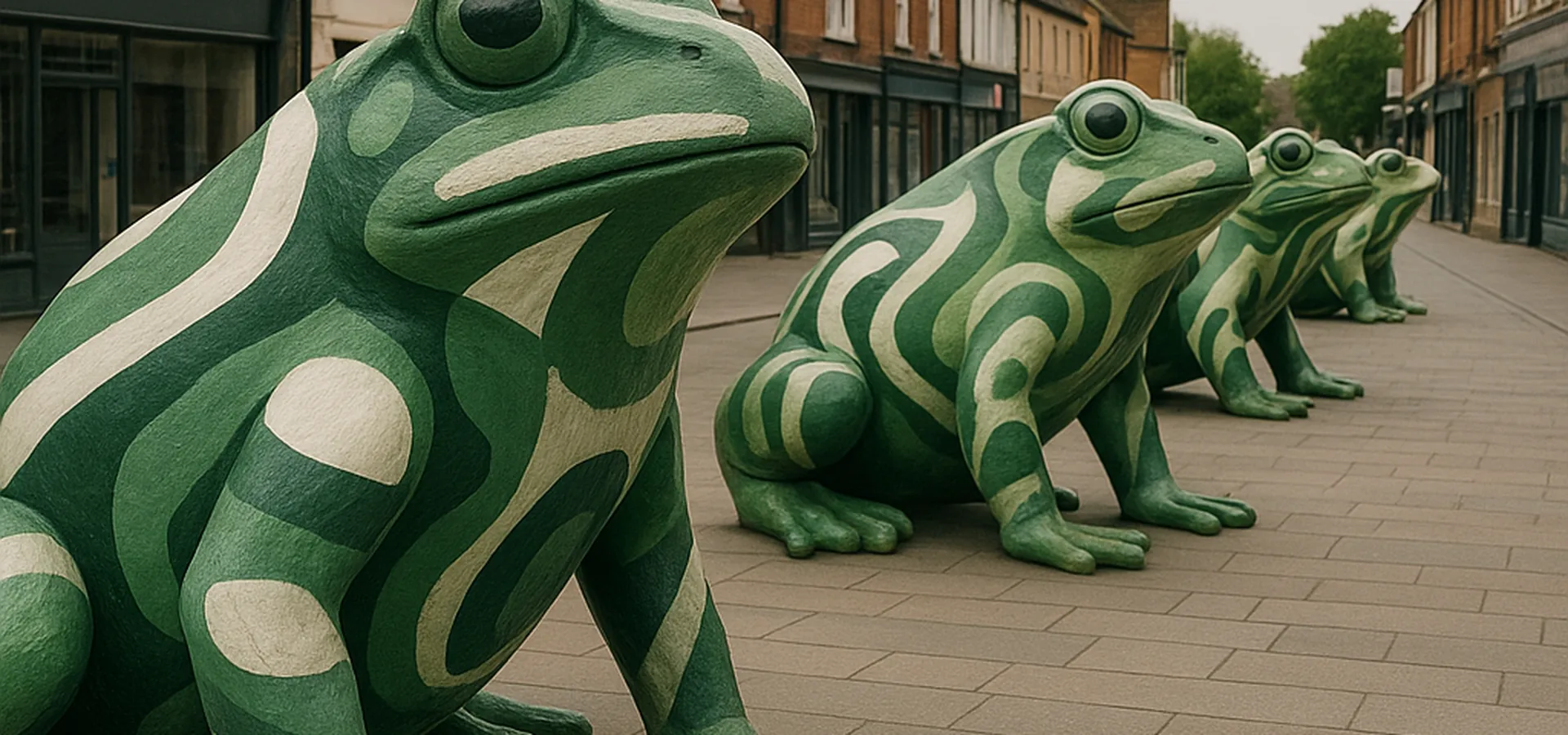
Public frog sculptures range from heavy, fixed works intended to remain outdoors for decades to painted shells made for a temporary art trail. Bronze, stone and fired ceramic can withstand long exposure when their design, finish and mounting suit the site. Trail pieces are usually hollow fibreglass, making them easier to transport and display than solid stone or metal. Material, construction and fixing offer practical clues to how long a sculpture is expected to stay in place.
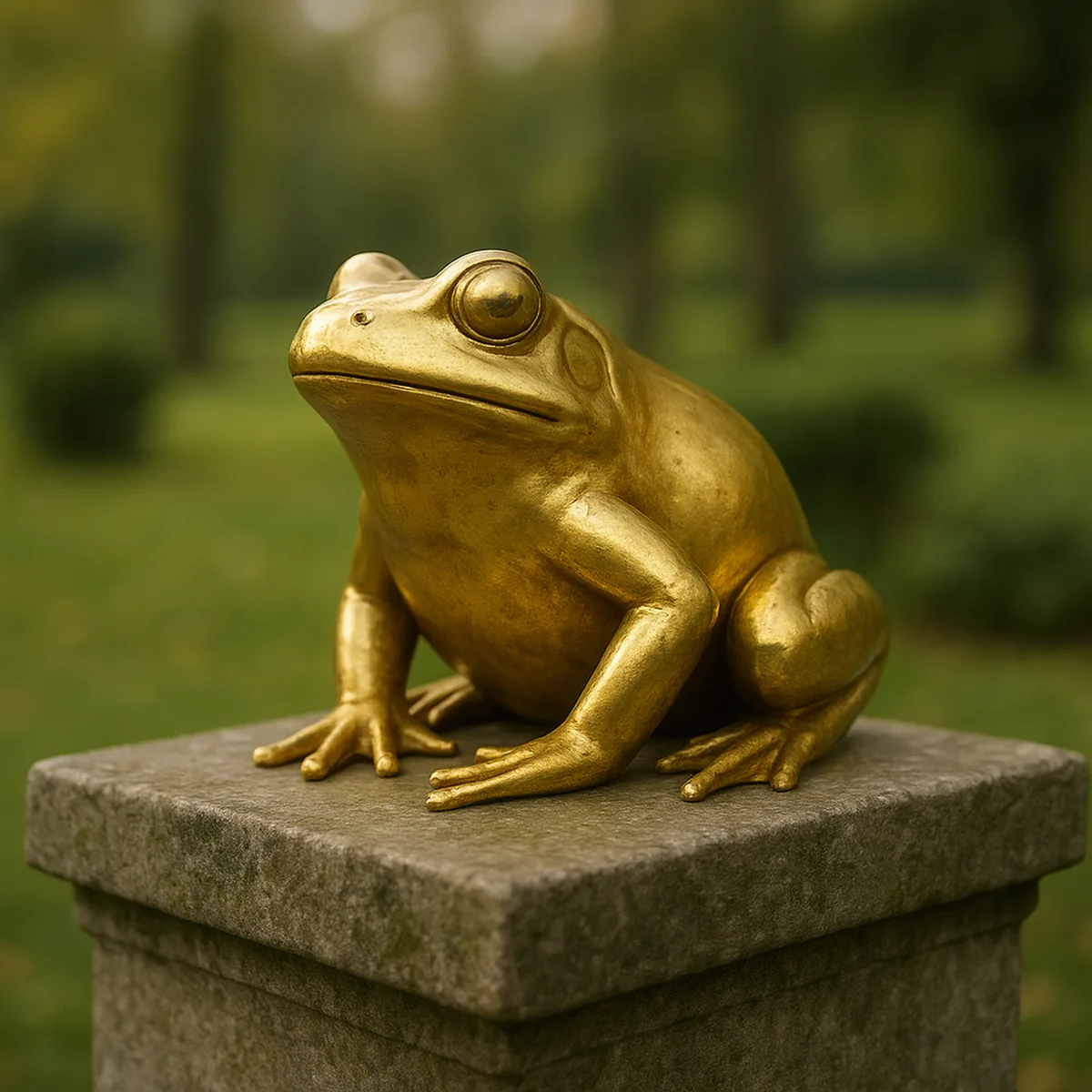
Bronze, stone and ceramic frogs
A permanent frog sculpture is designed around the weight and behaviour of its material: cast bronze needs secure fixing, carved stone needs stable support, and outdoor ceramic needs to resist water and frost. Surface finishes matter too; rain, airborne grime, freeze-thaw cycles and contact with people affect each material differently, so suitable sealing and maintenance depend on the sculpture and its setting.
These materials are not interchangeable. Bronze begins as a copper alloy, while stone is shaped from a single block or joined sections and ceramic is formed from clay and hardened in a kiln. The following construction details help explain what to look for:
- Bronze alloy: Sculpture bronze typically contains about 88 to 90 per cent copper, with tin making up much of the balance; small additions of other metals can vary by foundry.
- Lost-wax casting: A model is used to create a wax pattern, which is encased in a heat-resistant mould; the wax is melted out and molten bronze poured into the cavity.
- Stone carving: A sculptor roughs out a block with saws or point tools, then refines the frog’s contours with chisels and abrasives; granite and limestone weather differently.
- Ceramic firing: Clay is shaped, dried and kiln-fired; dense stoneware is commonly fired around 1,200 to 1,300°C, with a suitable glaze or body helping limit water absorption.
- Weathering and finish: Bronze develops a patina, while stone can collect lichen or show surface erosion; compatible wax or breathable treatments can reduce staining without trapping moisture.
- Mounting: Heavy pieces are commonly secured to a stone or concrete plinth with concealed pins or bolts; outdoor ceramic may use a fixed base to resist movement.
Sealing is a maintenance choice, not a guarantee against weather. Bronze may receive a protective wax after cleaning, and wax can need renewal; clear varnish is less common on exposed metal because a failing film can peel and require removal. Stone treatments should suit the particular stone, since a non-breathable coating can hold moisture inside porous material. For ceramic, a well-fired, low-absorption body and intact glaze are more useful outdoors than a surface coating alone.
Look for substantial weight, a permanent plinth, concealed mechanical fixings and a finish that has aged with the material. A cast signature or foundry mark can support identification, but the strongest permanence cues are robust construction and installation designed to remain in place.
Fibreglass frogs on art trails
Fibreglass is the standard material for many trail sculptures because it can form a large, detailed shell without the mass of solid stone or metal. Artists typically work on a moulded shell made from glass-fibre reinforcement and resin, then apply paint and a protective clear coat. An internal support or base helps the hollow form retain its shape and attach to a display stand.
Weight depends on the sculpture’s dimensions, thickness and reinforcement, so there is no single standard figure. Trail pieces are nevertheless much easier to lift and transport than an equivalent solid casting. The 1999 Chicago “Cows on Parade” project provides a prominent comparison: its fibreglass cows weighed around 580 pounds each, illustrating that a hollow public artwork can still require planned handling and a substantial base.
For a trail, an artist usually receives a prepared sculpture and decorates it with outdoor paints, imagery or applied materials. A clear varnish or similar topcoat helps protect the painted surface from rain, ultraviolet light and scuffing, although it can dull, scratch or need repair during a long display. The finished frog is placed at a chosen site, often on a base that allows it to be secured without building a permanent foundation.
After the public display, organisers remove the sculptures rather than leaving them as permanent street fixtures. Depending on the project, a piece may be sold, transferred to a new owner, stored or repainted for another use; its future depends on its condition and the trail’s arrangements. Compared with bronze or carved stone, a painted fibreglass frog is more readily moved, but its coating and shell need inspection after outdoor exposure.
Giant frogs and scale
Oversized frogs attract attention because their scale interrupts familiar street and park views. A sculpture several times larger than a person is easy to spot from a distance, while a form near human height can invite closer inspection without dominating its surroundings. Scale gives artists a way to make an ordinary animal shape read as a landmark, meeting point or playful interruption in a familiar setting.
Size affects the setting as much as the sculpture. A plinth raises the frog above paving, planting or a crowd, improving visibility but also changing its apparent height. Its footprint, weight and centre of gravity determine the support required; a large hollow fibreglass figure may need a firmly attached base, while a heavy cast or carved piece needs a suitably engineered foundation. The approach should leave the work visible from likely walking routes rather than hidden behind street furniture or dense planting.
Siting changes how a giant frog is perceived. Against low planting, a broad silhouette can appear even larger; beside a tall building, the same sculpture may seem modest. A raised viewpoint can make the back and surface pattern prominent, whereas a ground-level approach emphasises the head and face. These shifts in viewpoint are part of how public sculpture engages people moving around it, rather than simply looking at it from one fixed position.
Large dimensions also make the work legible across open spaces, where small details would disappear at a distance. Close up, surface texture, painted marks and the relation between the frog and its plinth become more apparent. For trail artwork installations, a change in scale can distinguish one stop from surrounding objects without requiring a complicated composition; the sculpture’s silhouette does much of the visual work.
From real frogs to frog art
Real frogs offer artists sharply different visual cues: saturated skin, compact bodies, long hind limbs and distinctive resting poses. A painting may emphasize the contrast between a frog’s back and belly, while sculpture can exaggerate its eyes or toe pads. Some artistic depictions draw on the extraordinary colours and proportions found in particular species. Cultural associations also shape how frogs appear in artworks, with meanings that vary between Egypt and Japan.
Golden frogs
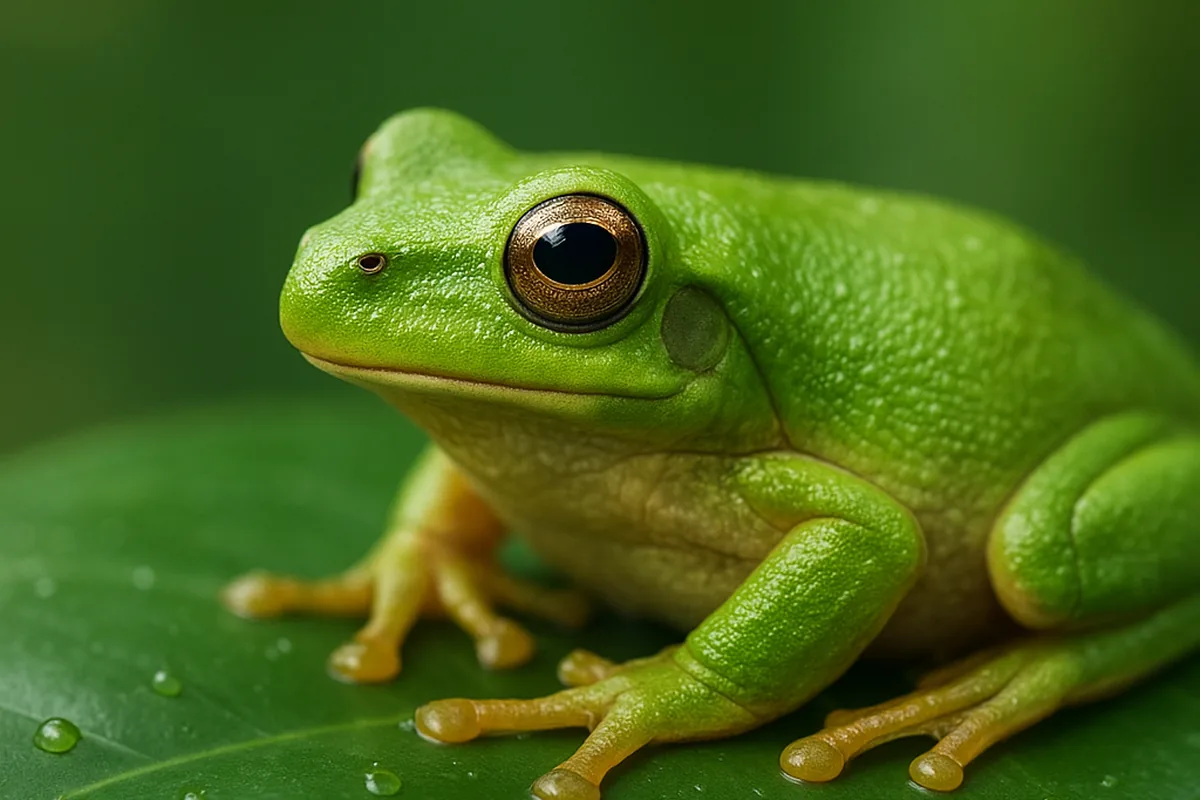
The golden poison frog (Phyllobates terribilis) is known for vivid yellow colouring, although individuals may also appear orange or green. Its brilliant, high-contrast appearance gives artists a striking reference for colour-focused frog designs, from naturalistic studies to simplified, graphic forms. The species lives only in Colombia, in humid forests of the country’s Pacific region. That restricted range makes its distinctive colour a specific feature of Colombian wildlife rather than a look shared by all frogs.
Giant frogs
The goliath frog (Conraua goliath) is the largest living frog, reaching about 32 centimetres in body length and weighing up to roughly 3.3 kilograms. Its broad head, powerful limbs and substantial body offer artists a way to play with scale, whether a work keeps realistic proportions or makes the frog appear monumental beside familiar objects. The species lives in Cameroon and Equatorial Guinea, in the fast-flowing forest rivers of the region.
Frogs as symbols in different cultures
In ancient Egypt, the frog-headed goddess Heqet was associated with fertility and childbirth, and frogs also became linked with renewal after the Nile’s annual inundation. In Japanese, kaeru means both “frog” and “to return,” which explains the use of frog charms as wishes for a safe return home. The wordplay also lends frog motifs a place in objects carried on journeys, where the animal’s image conveys that specific hope.
Frog art prints and wall art
A frog print can bring a small natural detail to a room or become the main focus above a sofa, desk or bed. The paper, printing process and image all affect its appearance, so consider them together rather than choosing by subject alone. Room dimensions, daylight and existing colours help determine whether a detailed study or a simpler design will sit comfortably on the wall. A suitable frame and thoughtful placement help preserve the image over time. The following comparisons cover print processes, style choices and practical care.
Types of print
Printing processes leave distinct surfaces and marks. Giclée is an inkjet process using pigment inks on art paper; screen prints and linocuts are hand-pulled, with a separate layer of ink applied for each colour. Poster prints are usually produced for broad distribution, and their finish depends on the printer and paper selected.
| Type | Look | Durability | Typical paper | Use at home |
|---|---|---|---|---|
| Giclée | Fine tonal transitions and detailed lines; pigment ink is laid down by inkjet. | Depends on ink, paper and display conditions; pigment inks on suitable art paper are chosen for lasting image quality. | Matte or lightly textured art paper, often a substantial, cotton or alpha-cellulose sheet. | Well suited to fine botanical realism, subtle colour and detailed frog studies in living rooms or bedrooms. |
| Screen print | Flat, saturated colour and crisp shapes; each colour is printed through a separate screen. | Ink sits visibly on the paper; resistance to fading depends on the ink and exposure to light. | Uncoated printmaking paper, commonly with enough weight to take several ink layers. | Works well for bold graphic images and limited palettes in a hallway, study or contemporary living space. |
| Linocut | Carved lines and textured areas create a distinctive, handmade appearance; each colour requires its own ink layer. | Printed ink can remain stable when kept out of strong light; pressure and hand application can produce small variations. | Printmaking paper with a smooth or lightly textured surface that accepts hand-applied ink. | A good choice for a single frog silhouette or high-contrast design in a reading nook or bedroom. |
| Poster print | Usually clean, even colour and a straightforward reproduction of the image. | Paper and inks vary by production run; lightweight stock can crease more readily than art paper. | Coated or uncoated poster paper, often lighter than specialist printmaking paper. | Practical for a large, casual display or a changeable arrangement in a kitchen, office or child’s room. |
Standard ISO paper sizes can help when planning a frame: A4 measures 210 × 297 mm, A3 is 297 × 420 mm, and A2 is 420 × 594 mm. A print may be smaller than its frame opening when a mount is used.
Choose giclée for delicate tonal detail, a screen print or linocut for visible handmade character, and a poster print for an uncomplicated, changeable display. In every case, the paper’s surface and image scale should suit the wall rather than compete with it.
Choosing a subject and style
Start with the wall’s dimensions and the distance from which the image will usually be seen. In a narrow hallway or small study, a single frog, restrained palette or fine botanical realism keeps the composition legible without making the wall feel crowded. In a larger living room, a broad composition or several coordinated images can hold attention across a wider area.
Light changes how colours and detail read. A dim bedroom can benefit from a pale ground and clear outlines, while a bright room may suit deeper greens, inky tones or a high-contrast image. On a wall opposite a window, consider how glazing might reflect daylight; a quieter composition with clear shapes is easier to read when reflections cannot be eliminated.
Botanical realism suits a living room, study or bedroom where natural details and muted decor feel at home. Cartoon frogs bring clear shapes and lively colour to a child’s room or informal kitchen. Japanese-inspired compositions often use deliberate empty space and a limited palette, making them effective in a calm bedroom or small entryway. Abstract frog forms suit a contemporary living room or office, especially when their colours echo one or two existing accents.
Match the frame and mount to the image as well as the decor: a broad pale mount can give a small, detailed print breathing room, while a narrow frame keeps a bold graphic design compact. For frog-themed art that should feel subtle, choose a single naturalistic study; for a focal point, select a larger graphic or abstract composition with colours already present in the room.
Looking after a framed print
A framed print is protected by its glazing and backing, but poor placement or careless handling can still cause fading, marks or distortion. These steps help keep paper and ink in good condition.
- Choose UV-protective glass or acrylic glazing to reduce ultraviolet exposure; it does not make a print safe in direct sunlight, so keep strong sun off the frame.
- Use a clean, acid-free mount to separate the print from the glazing and backing; avoid letting the image surface touch the glass.
- Hang the frame away from direct sun, radiators, fireplaces and damp areas, where heat or moisture can stress paper and frame materials.
- Keep indoor humidity reasonably stable and avoid bathrooms or other rooms with repeated steam; sudden moisture changes can make paper cockle.
- Dust the frame with a soft, dry cloth; clean the glazing separately and apply cleaner to the cloth, never directly onto the frame.
- When moving a framed print, hold both sides of the frame rather than the hanging wire, and keep it upright rather than face-down.
- For an unframed print, handle it by the edges with clean, dry hands and support the full sheet to prevent creases.
Check the frame’s hanging fittings periodically and make sure the print remains flat within the mount. A shaded wall, UV-protective glazing and careful handling provide a practical baseline for long-term display.
Questions about frog art
Frog art ranges from close studies of living amphibians to imaginative designs that use a frog shape as a starting point. Artists work in two and three dimensions, and their choices can change how realistic, playful or monumental a subject appears. Public artworks also have different lifespans: some are designed to remain in place, while others form part of a temporary display. The distinctions below clarify common terms and materials.
What is frog art?
Frog art is any creative work that depicts frogs or uses frog forms as its subject or motif. It includes a frog art painting, as well as drawings, illustrations, prints, textiles and digital images. Three-dimensional examples range from small handmade figures to large outdoor installations in parks or town centres. Artists may observe the anatomy, colour and posture of a real species, or simplify those features into a decorative pattern or character. The term covers realistic wildlife studies and imaginative work, provided the frog remains a recognisable subject or influence.
Why are frogs popular in art?
Frogs are popular in art because their distinctive shapes are easy to recognise and can carry several meanings. Large eyes, folded hind legs and varied skin colours give artists clear visual features to exaggerate or render precisely. In stories and folklore, frogs can suggest transformation, renewal, luck or comic mischief, although meanings differ between cultures and individual works. Their association with ponds and wetlands also makes them useful subjects for nature-focused imagery. A single frog can therefore read as a wildlife study, a character or a symbol.
What are frog sculptures made of?
Frog sculptures are commonly made from bronze, stone, ceramic or fibreglass, with the material affecting their weight, finish and expected lifespan. Bronze can be cast in detailed forms and is suited to long-term outdoor display; stone is heavy and durable, though its surface and detail depend on the type of stone and carving. Ceramic is often glazed and fired, making it suitable for smaller works, but it can crack if struck. Fibreglass is lighter and can support large, brightly painted designs, though outdoor coatings may need maintenance. Bronze and stone sculptures are permanent works, unlike temporary trail pieces.
Are frog art trails permanent?
No, sculptures created for frog art trails are temporary, even when they are built to withstand outdoor conditions. Organisers typically display them for a defined event or season, then remove them for storage, repair, auction or reuse. Weather exposure, handling and the condition of painted finishes can affect how long a particular work remains suitable for display. This makes trail artwork installations different from bronze or stone sculptures intended to stay in a fixed public location. Giant trail frogs may be large and robust, but their presence on a route is still time-limited.
What is the difference between a frog and a toad in art?
In biological terms, frogs generally have smooth skin and long legs, while toads usually have drier, warty skin and shorter legs. These traits help artists signal which animal they are depicting, but the terms are also used loosely in titles, stories and popular imagery. “Toad” does not describe one single scientific group, and appearance alone can be misleading across many amphibian species. The Panamanian golden frog, Atelopus zeteki, is called a frog but is in fact a toad in the family Bufonidae. Its familiar name therefore does not match its classification.
Our guide
An independent guide to Stockport frog art and trails
Frog Trail Notes is an independent guide to frog art and public sculpture. It explains materials, giant trail frogs, golden frogs and the frog as a symbol, with a look at the Stockport frog trails as public art.